

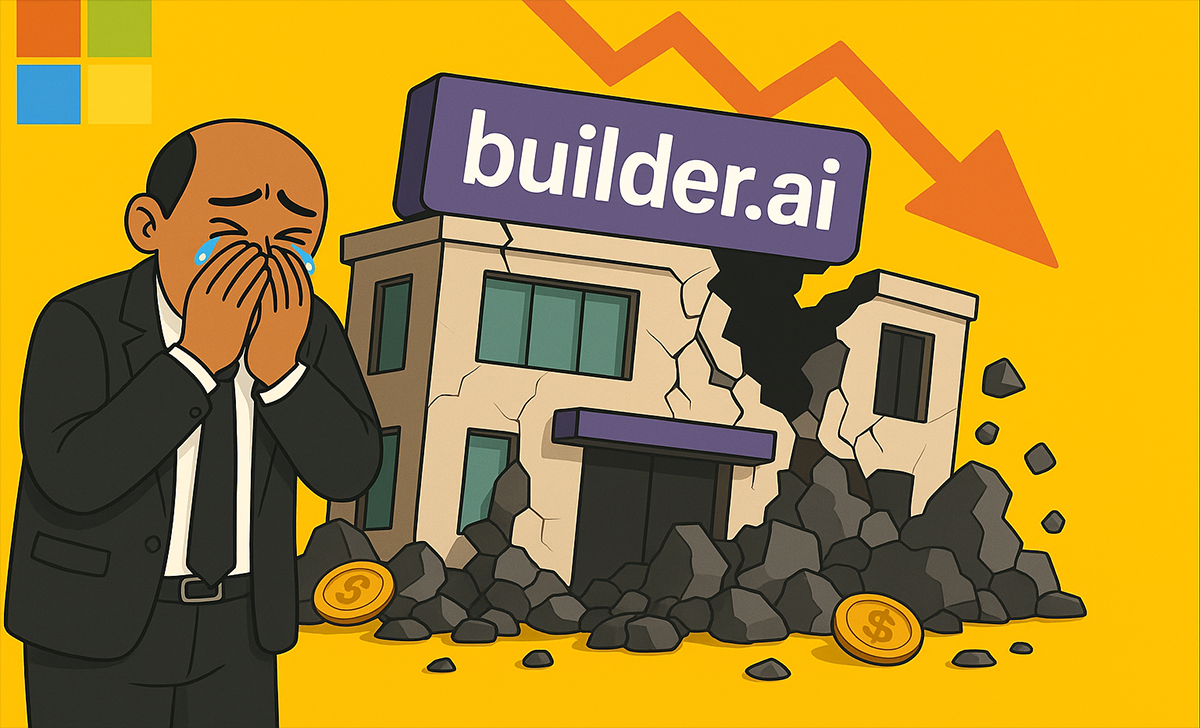
Builder.ai, a company that offered app development, went bankrupt in May 2025. It promised simple app creation. But its finances held inflated revenue, false claims along with poor money handling.
A Look Back
The company began in 2016 as Engineer.ai – it presented a simple proposal – tell it what your app needed, and its AI helper, “Natasha,” would construct it. It collected $445 million from investors such as Microsoft, SoftBank as well as Qatar’s sovereign wealth fund. The company’s worth reached $1 billion by 2023. The promise? App creation for anyone, no coding required.
The Collapse Timeline
Feb 27, 2025: Founder Sachin Dev Duggal steps down as scrutiny mounts.
Early May 2025: Lenders freeze $37–$50 million over financial irregularities.
May 20, 2025: Builder.ai files for Chapter 7 bankruptcy in Delaware. Liabilities: up to $100 million. Assets: under $10 million.
Why It Fell Apart
1. Fake Revenue and Phantom Deals
Audits revealed that Builder.ai exaggerated its revenue by more than half. Its claimed $180 million in 2023 dropped to $45 million. In 2024, $220 million fell to $55 million. Round-tripping caused the drop.
Builder.ai and other partners, like VerSe Innovation, owner of Dailyhunt, charged one another for services. But the services did not occur. The company also announced bigger contracts and false reseller agreements – it collected deposits that never became real business.
Lenders saw the pattern; they withdrew their money, so the whole operation failed.

2. The “AI” did not work as advertised.
Builder.ai called itself an AI platform. It used about 700 engineers in India. They wrote app code by hand. The AI helper, “Natasha,” was more a marketing trick than a real item. It was a smooth interface that hid common outsourcing.
This wasn’t a stretch of the truth. It was AI-washing.
3. Burned Through Cash
With nearly half a billion dollars raised, Builder.ai expanded rapidly 770 employees across multiple countries. But internal financial controls were lacking. When the truth about its revenue surfaced, it was already too late. Layoffs came, but the damage was done.
Damage Control and Legal Trouble
Spy Firms and Crisis PR
After the Financial Times published a damning exposé, Builder.ai hired:
Shibumi Strategy (staffed by ex-Mossad agents)
Quinn Emanuel (elite law firm)
Sitrick Group (crisis PR)
They spent millions trying to contain the fallout money the company didn’t have.
Investigations Underway
U.S. Attorney’s Office issued subpoenas.
India opened a criminal probe into Duggal.
VerSe is also under investigation for its role in the round-tripping.
What This Means for AI Startups
1. The Hype Cycle Is Over
“AI-powered” isn’t enough.Investors Want Proof, Not Hype
Empty promises don’t cut it anymore. Investors are done with flashy decks and vague claims. They want traction, not buzzwords.
2. Keep the Books Clean
Faking numbers isn’t clever—it’s fraud. Clear, accurate financials aren’t a bonus—they’re the bare minimum.
3. You Can’t Scale Chaos
Growing fast without a real foundation is reckless. Investors and boards are tightening expectations. Systems, controls, and accountability matter now.
4. Trust Breaks Fast
Every scandal chips away at trust in the tech industry. The only way to fix it? Be transparent. Deliver value. Skip the shortcuts.
What’s Next
Investor behavior is already changing. Due diligence now includes customer calls, code reviews, and real product testing. Regulators are stepping in too, tightening the rules around financial disclosures and AI marketing claims.
The Bottom Line
Builder.ai didn’t fail because it aimed too high—it failed because it lied. It sold an illusion instead of a product.
The message is clear:
Founders need to build real solutions.
Investors need to ask tougher questions.
Users should stay sharp.
AI’s future depends on all three.